


The Investment Wave Is Building — But What Lies Beneath the Growth?
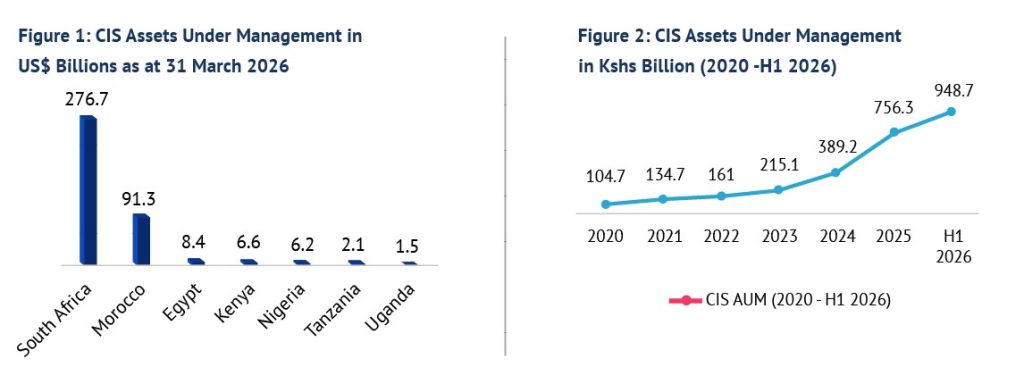
Kenya’s asset management industry gained significant momentum over the last five years to 31 December 2025, with assets under management (AUM) across collective investment schemes (CIS) expanding at a 48.5% compound annual growth rate (CAGR) from the 31 December 2020 base, reaching Kshs 756.3 billion1. This growth reflects the country’s rising financial inclusion, which stands at circa 84.8%2, supported by mobile money adoption, increased investor awareness and growing demand for professionally managed investment solutions. The momentum continued into 2026, with CIS AUM increasing by 25.4% to Kshs 948.7 billion3 over the six months to 30 June 2026, albeit at a slower pace than the 53.2% growth recorded over the comparable period in the previous year. We note that the moderation in growth in H1 2026 reflects a more measured demand for income-generating and alternative investment products, although investor appetite remained supportive of AUM expansion. We estimate CIS AUM to grow by a further 20% in H2 2026, reaching approximately Kshs 1.1 trillion by year-end, supported by continued demand for income-generating investment products amid a lower interest-rate environment and growing investor adoption of alternative investment solutions. Despite this growth, Kenya remains a relatively small CIS market compared with leading African peers. As at 31 March 2026, South Africa had approximately USD 276.7 billion in AUM, compared with USD 91.3 billion in Morocco, USD 8.4 billion in Egypt, USD 6.6 billion in Kenya and USD 6.2 Billion in Nigeria. This highlights the considerable room for growth, in Kenya’s asset management industry, supported by the 22.9% CAGR in pension assets under management over the three years to June 2026, a growing middle class, deeper participation in formal financial products and an expanding range of investment solutions. The Capital Markets (Collective Investment Schemes) Regulations, 2023 establish requirements covering licensing, governance, custody, disclosure and reporting of funds’ financial information, which we believe should be accompanied by stronger risk management frameworks to support sustainability. The effectiveness of these regulations, however, depends on consistent implementation, adequate disclosure quality and investor understanding. As the investment wave builds, the key question is not only how fast the industry can grow, but how well investors can see the risks beneath the returns.
Source: The Capital Markets Authority (Kenya) – Capital Markets Soundness Report, Q1 FY 2025/26 and Agusto & Co. Research
The Yield Hunt Is Growing — But What Lies Behind the Returns?
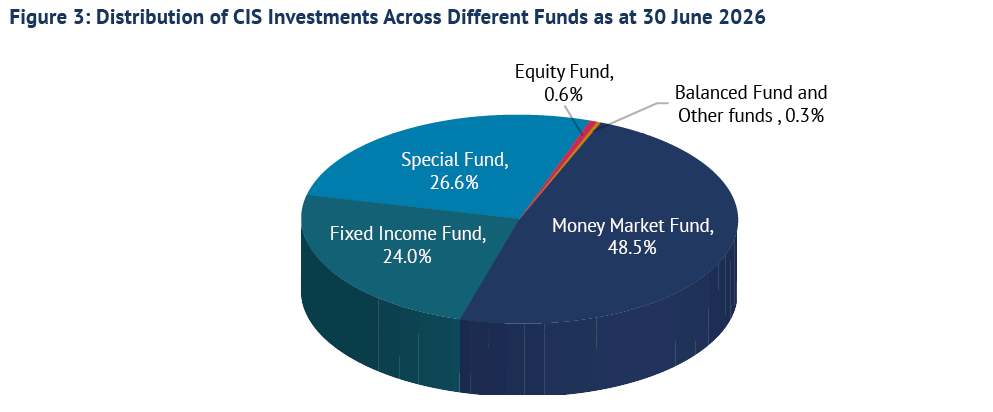
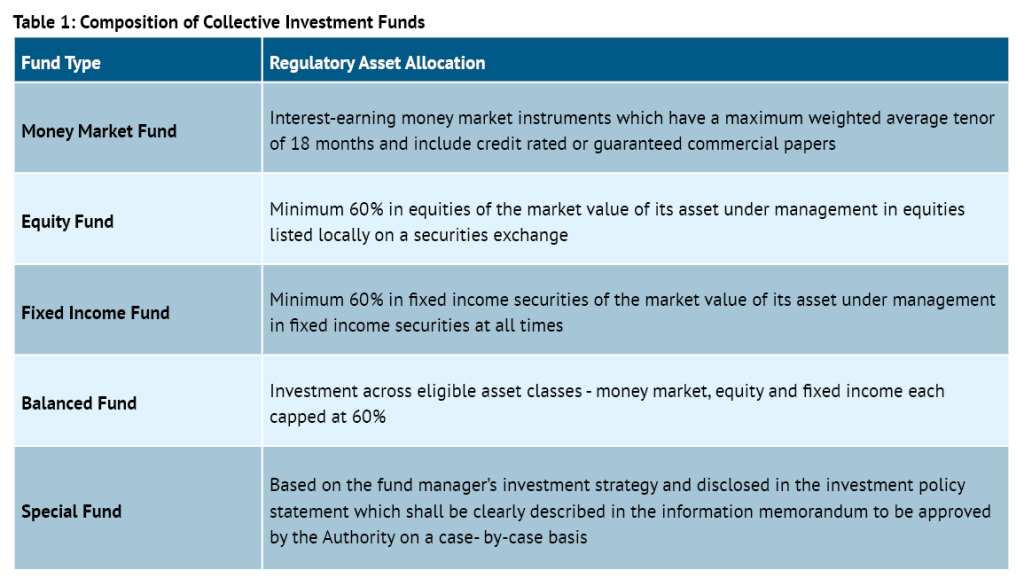
Investor preferences are also evolving, with a notable shift from predominantly money market funds towards a broader range of products, including fixed income funds and alternative investments. As at 30 June 2026, money market funds (MMFs) accounted for the largest share of CIS AUM at 48.5%, equivalent to Kshs 459.8 billion, special funds (SFs) which are CIS products that provide exposure to niche strategies and asset classes, including derivatives, offshore assets and commodities, accounted for 26.6% at Kshs 252.8 billion, while fixed-income funds (FIF) represented 24% at Kshs 228.1 billion. Relative to the position at the end of 2025, MMFs’ share declined from 56% to 48.5%, while SFs and FIFs increased from 21.5% and 21.7%, respectively, to 26.6% and 24%. The shift points to growing investor interest beyond capital preservation and liquidity towards potentially higher-yielding and more diversified investment opportunities. Special funds4 were formally recognised as a distinct CIS investment category under the Capital Markets (Collective Investment Schemes) Regulations, 2023, reflecting a regulatory move to accommodate a broader range of investment strategies and asset classes. The broader permissible asset classes including traditional and non-traditional assets such as commodities, derivatives, offshore assets, private debt and other alternative investments, creates opportunities for diversification and potentially higher long-term returns. Looking ahead, the growing interest in special funds supported by their access to alternative asset classes and strategies with potential for higher returns could enhance their role in mobilising long term capital. Nevertheless, their greater complexity, may limit accessibility for some investors, while making transparency around credit quality, liquidity and underlying risks increasingly important.
Source: The Capital Markets Authority (Kenya) and Agusto & Co. Research
What Lies Beneath the Yield?
A fund’s return is significantly influenced by the assets it holds, making the credit quality of the underlying issuers and instruments central to understanding the risk behind the yield. What matters is what sits behind it, the quality and risk of the underlying assets. While regulations prescribe the types and composition of assets that funds can hold, these can carry very different levels of credit, liquidity and market risk. As a result, two funds offering similar yields may expose investors to materially different levels of risk. As investors increasingly move beyond capital preservation in search of competitive returns, understanding what sits beneath the yield, including credit, liquidity, market, duration, currency, valuation, concentration, operational and regulatory risks, becomes increasingly important.
Source: Capital Markets (Collective Investment Schemes) Regulations, 2023 and Agusto & Co. Research
Beyond the Yield — What Fund Managers Need to See
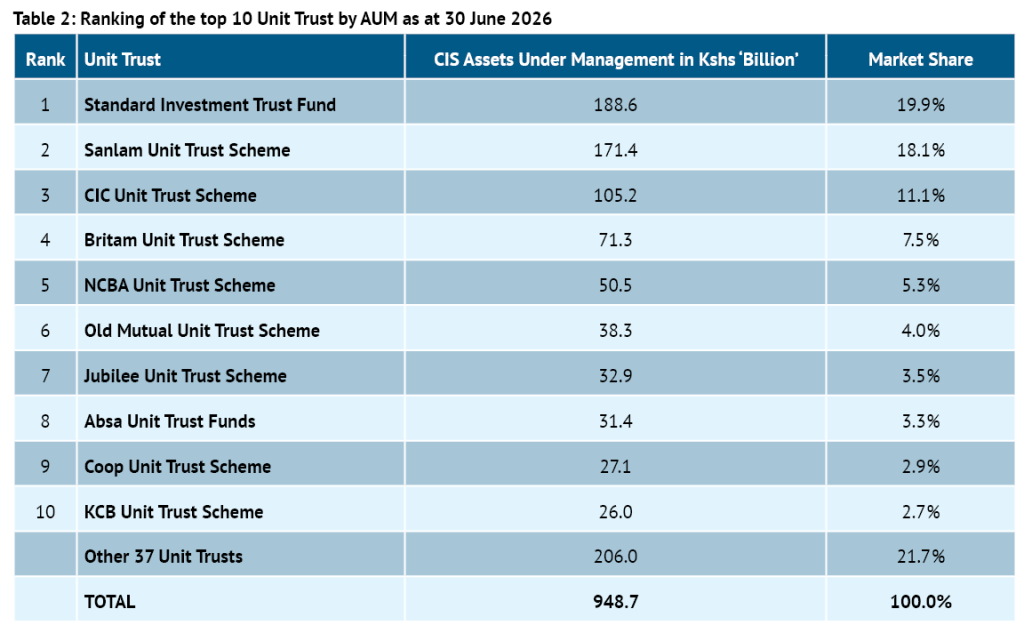
Fund managers play a critical role in looking beyond headline yields to assess the credit quality of the issuers and instruments underpinning investment returns. This is particularly important given the concentration of Kenya’s CIS market as the top 10-unit trust schemes accounted for 78.3% of the total industry AUM as at 30 June 2026, underscoring the significant influence of leading managers on how investors’ funds are allocated. Credit rating complement fund managers’ internal due diligence when assessing certain issuers and instruments such as commercial papers and corporate bonds by providing an independent external perspective on creditworthiness. However, a rating is not a substitute for portfolio-level due diligence and does not fully capture the valuation and regulatory risks. The dominance of established schemes is likely to persist in the near term given their scale, established track records, distribution networks, investor familiarity and ability to offer competitive products. However, stronger product differentiation, digital distribution, investment performance, pricing and access to specialised asset classes could create opportunities for newer managers to gain market share. As competition intensifies and investors seek attractive yields across a broader range of asset classes, robust credit evaluation will therefore become increasingly important for fund managers seeking to balance competitive returns with the underlying risks borne by investors.
Source: The Capital Markets Authority (Kenya) and Agusto & Co. Research
Building Confidence Beyond the Yield
Fund managers, distributors and other licensed market intermediaries are broadening the range of investment products available to Kenyan investors, subject to the roles and responsibilities prescribed under the CIS regulatory framework. As these products become more diverse, independent credit quality assessments could strengthen transparency by providing investors with an external assessment of risk while helping providers communicate and differentiate their offerings. The need for greater risk visibility is reinforced by the scale and concentration of Kenya’s CIS market. As at 30 June 2026, the top five money market funds accounted for 59.9% of total MMF AUM, while the top five fixed-income funds and special funds accounted for 74.2% and 89.3%, respectively. This concentration underscores the importance of understanding the underlying credit quality and risk exposures of the leading funds, particularly where portfolios contain corporate debt, commercial paper, deposits and other credit-sensitive instruments. Independent fund assessment can therefore complement asset managers’ internal due diligence by providing an additional perspective on these exposures. Furthermore, given the predominantly retail nature of the industry, with circa 4.1 million CIS investors as at 30 June 2026, of whom 98% were local retail investors, robust risk assessment, monitoring and clear communication of investment risks remain critical.
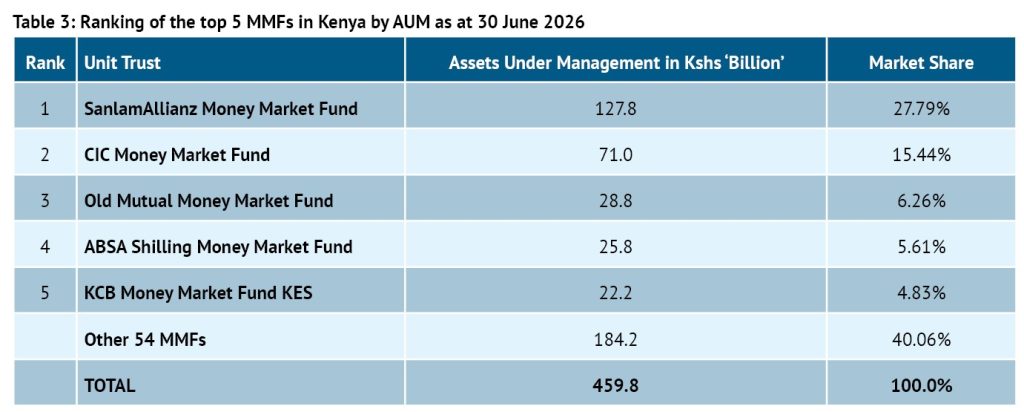
Source: The Capital Markets Authority (Kenya) and Agusto & Co. Research
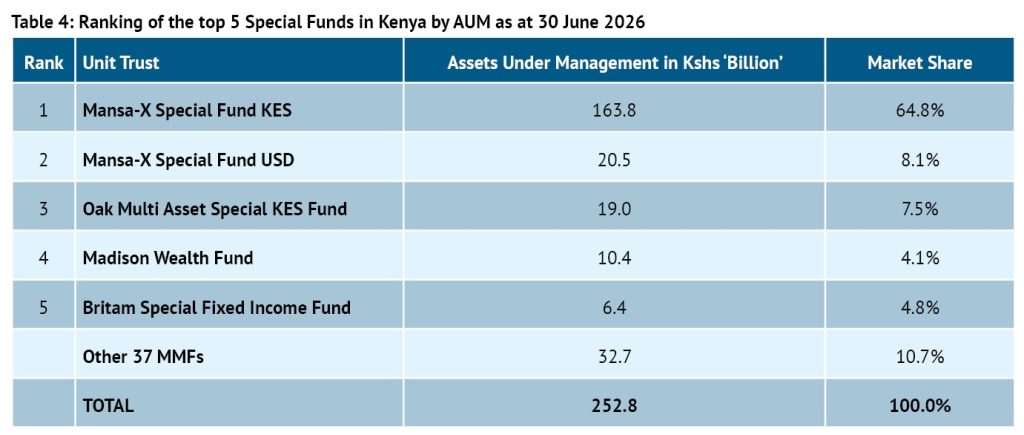
Source: The Capital Markets Authority (Kenya) and Agusto & Co. Research
Looking ahead, growing demand for diversified investment products and increasing competition among fund managers could reshape the industry, making credible risk differentiation increasingly important. In our view, greater transparency around credit quality should become a more prominent part of investor communication, with independent third-party assessment providing an additional layer of confidence
and visibility into the risks supporting headline returns.
When Yield Meets Credit Risk — Is the Market Ready for What Comes Next?
For investors, the question is no longer simply how much a fund earns, but what risks support that return. For fund managers, product originators and investment institutions, the challenge is increasingly to ensure that those risks are properly assessed, understood priced and communicated as investment products become more diverse and sophisticated. Kenya’s rapidly expanding CIS market, growing appetite for yield and rising exposure to a wider range of asset classes point to a market that is entering a new phase – one in which return and risk visibility need to evolve together.
The Next Wave: Making Risk More Visible
As Kenya’s asset management industry and collective investment schemes deepen, credit risk assessment should evolve alongside product innovation. Independent credit ratings are not a substitute for fund managers’ due diligence, nor does every investment product necessarily require a rating; rather, they can provide an additional layer of independent analysis that strengthens transparency, risk visibility and investor communication. With millions of predominantly retail investors increasingly seeking competitive returns across a broader range of products, the question for the industry is perhaps no longer whether investors want yield, but whether they can clearly see the risks beneath it. The next stage of Kenya’s investment journey may therefore depend not only on creating more products, but on making the risks within those products easier to understand.
